


Best UK eSIM for US Tourists (2026): Coverage & Top Picks
By Elias Voss — June 2026
Staying connected while visiting the UK has never been easier thanks to eSIM technology. A UK eSIM lets you get mobile data instantly without buying a physical SIM card at the airport or a store, and you can activate it before you even leave home. That means you can start using maps, booking rides, and messaging the moment you land in London, Edinburgh, Manchester, or anywhere else in Britain.

Traditional SIM cards often require you to wait in line at a store, show your passport, and wait for activation. With a UK eSIM, you simply scan a QR code on your phone and you're ready to go. Most modern smartphones support eSIM technology, making it the easiest option for tourists in 2026.
Choosing the right UK eSIM plan depends on how long you're staying and how much data you need. Prices start from around $5, and you can find plans with 4G and 5G coverage across England, Scotland, Wales, and Northern Ireland. This guide will help you compare the best options so you can stay connected without overpaying or running out of data.
Key Takeaways
- eSIMs offer instant activation and better value than traditional SIM cards for UK visitors
- eSimpli offers Standard plans from $5 and Unlimited plans from $20 — with 24/7 support and instant QR delivery
- Coverage and speed vary by provider, with some performing better in rural areas than others
- Choose your data plan based on trip length and whether you need voice calls or just mobile internet
Why Tourists Should Choose eSIMs Over Traditional SIM Cards
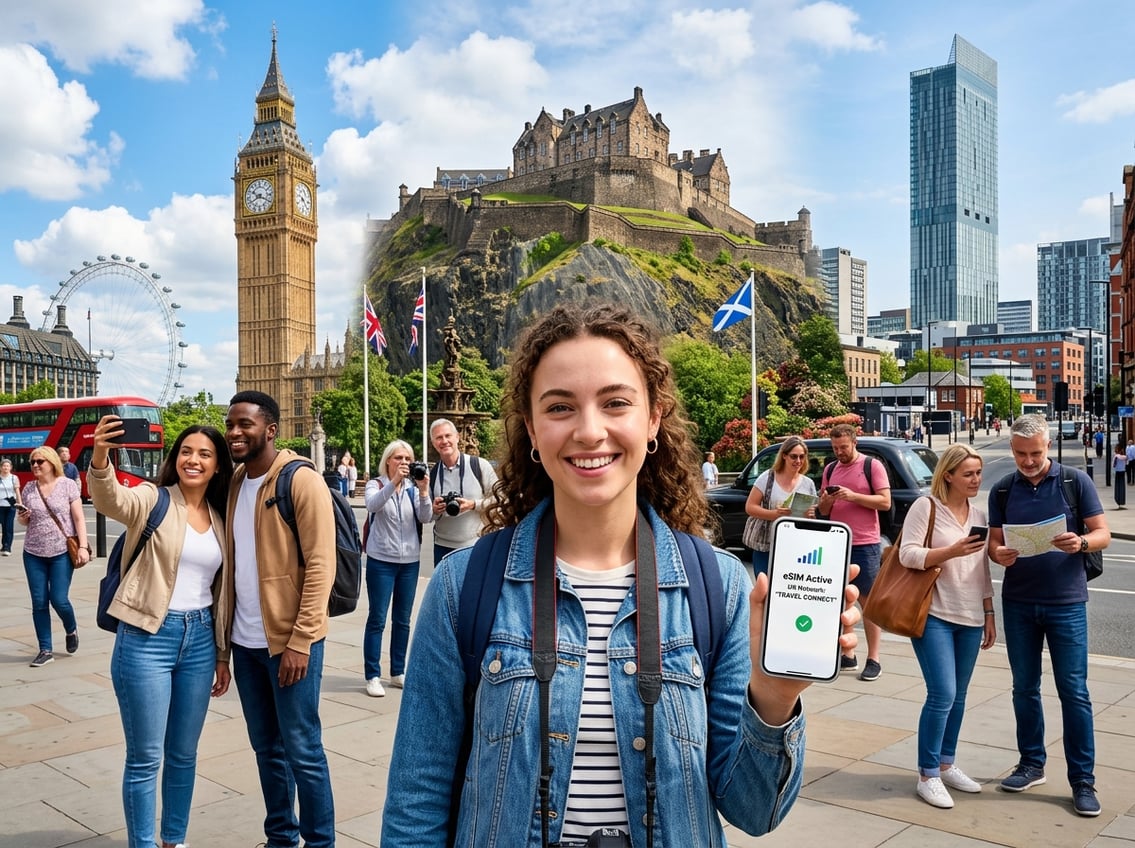
eSIMs eliminate the need to hunt for stores selling physical SIM cards or swap out your home SIM upon arrival. They activate in minutes, work alongside your existing number, and give you complete control over your UK connectivity without carrying multiple cards or visiting cell phone stores.
Instant Connectivity Upon Arrival
An eSIM activates within 3-5 minutes of purchase. You can buy and install your UK eSIM before your flight takes off, so you land at Heathrow, Gatwick, or Edinburgh Airport with working data immediately.
Traditional UK SIM cards require you to find a cell phone store or vending machine after arrival. Many airport stores close by 10 PM, and lines can stretch 20-30 minutes during peak hours. If you arrive late or on a Sunday when stores are closed, you might wait until the next day for connectivity.
With an eSIM, you scan a QR code or use direct app installation while still at home. The moment your plane lands and you turn off airplane mode, you're connected to EE, Three, or Vodafone networks. No hunting for stores. No waiting in line. No dealing with unfamiliar payment systems.
That instant connection matters when you need to book a ride, message your hotel, or pull up directions to your accommodation.
Keeping Your Home Number Active
A UK eSIM runs alongside your regular SIM card. You keep your home number active for calls and texts while using the eSIM exclusively for data.
When you insert a physical UK prepaid SIM card, you have to remove your home SIM. You'll miss calls and texts sent to your regular number unless you swap cards back and forth throughout your trip. This creates real problems if you need to receive two-factor authentication codes, work calls, or emergency messages from family.
eSIMs solve this completely. Your home number stays in the primary SIM slot. The UK eSIM handles all data. You can set your phone to:
- Use your home number for calls and SMS
- Use your UK eSIM for mobile data, maps, and apps
- Receive calls on both numbers simultaneously
If someone from home calls, it comes through normally. If you need data for Google Maps or booking a restaurant, it routes through your UK eSIM with local rates instead of international roaming charges.
Convenience and Flexibility for Travelers
Physical UK prepaid SIM cards require you to visit a cell phone store, present ID, complete paperwork, and wait for activation. The process takes 15-45 minutes depending on the store and time of day.
eSIMs install from your hotel room, the airport lounge, or your departure gate. You control everything through an app. Need more data mid-trip? Top up instantly without finding a store or speaking to staff.
You can also purchase multiple eSIMs before traveling. If you're visiting England, then continuing to France or Spain, you can install regional eSIMs and switch between them in settings without carrying multiple physical cards or worrying about losing them.
Traditional SIM cards are small, easy to lose, and can be damaged. The nano-SIM tray on modern phones is tricky, and tourists frequently drop or misplace the tiny cards while swapping them at airports or hotels.
Security and Compatibility Considerations
eSIMs cannot be physically stolen from your phone. If someone takes your device, they cannot remove the eSIM and use it in another phone the way they can with a physical SIM card. That adds a layer of theft protection.
Most phones from 2020 onwards support eSIM technology, including iPhone XS and newer, Samsung Galaxy S20 and newer, and Google Pixel 4 and newer. Check your phone's settings under "Mobile Data" or "Cellular" for an "Add eSIM" option before purchasing.
UK prepaid SIM cards work in any unlocked phone, which gives them broader compatibility with older devices. If you're traveling with a phone from 2018 or earlier, a physical SIM card might be your only option.
eSIMs also reduce plastic waste. The UK disposes of millions of SIM cards annually, each made of PVC plastic. Switching to eSIMs eliminates that physical waste entirely while giving you faster, simpler connectivity across London, Edinburgh, Manchester, and the rest of the UK.
Comparing Data Plans and Pricing in 2026

UK eSIM plans range from under $1 per day to $20 for unlimited data, with the best choice depending on your trip length and data needs. eSimpli's UK plans cover both Standard (fixed data) and Unlimited options, run on Three, O2, and Vodafone networks, and include tethering at no extra cost. All prices below are in USD.
Short Trip and Long Stay Data Options
For trips under seven days, 1GB to 3GB plans provide enough data for maps, messaging, and social media. eSimpli's 1GB plan costs $5 for 7 days, and their 2GB plan covers 15 days for $7 — a solid option for a long weekend.
Week-long visitors using video calls and social media should consider a 5GB plan. eSimpli's 5GB/30-day plan runs $11, which is among the best value in the market. For heavier use, the 10GB/30-day plan is $15 (currently discounted from $17).
Longer stays need a different calculation. If you're spending two weeks or more in London, Edinburgh, or Manchester, larger data packages offer better value. eSimpli's 20GB plan is $29 for 30 days ($1.45 per GB), and their 50GB plan covers the heaviest users at $52.
All eSimpli plans activate on your first connection to a UK network, and you have a 60-day window from purchase to activate — so you can buy ahead of time without any pressure.
Unlimited Plans vs. Pay-as-You-Go
eSimpli's Unlimited plans start at $20 for 5 days, $24 for 7 days, and $32 for 10 days. Each plan includes 1GB of full-speed 4G/5G data per day, after which speeds reduce to 1.25 Mbps — fast enough for maps, WhatsApp, and social media, but not video streaming. Full-speed resets every 24 hours. Tethering is included.
Holafly also offers unlimited plans starting around $19 for 5 days. Speeds may occasionally slow during peak hours under a Fair Usage Policy, with normal speeds returning the following day. Hotspot sharing is capped at 1GB per day with Holafly.
Pay-as-you-go models suit lighter users better. You purchase a fixed amount — say 5GB or 10GB — and use it at your own pace within the validity period. It's cheaper upfront but requires monitoring your usage.
The break-even point sits around 2-3GB per day. If you consistently use more than that, unlimited plans cost less. If you use 500MB to 1GB daily for casual browsing and navigation, a Standard plan saves money. All eSimpli plans support tethering, so you can share data with your laptop at no extra charge.
Price Comparison by Provider
Pricing varies significantly across providers, even when using the same underlying network:
| Provider | 1 GB | 5 GB | 10 GB | 20 GB | Unlimited | Networks |
|---|---|---|---|---|---|---|
|
eSimpli RECOMMENDED |
$5 | $11 🏆 | $15 🏆 | $29 | From $20 /5 days |
Three, O2, Vodafone |
| Airalo | $5 | $15 | — | — | — | EE |
| Saily | $4.49 | ~$15 | $19.99 | $30.39 | — | EE, Three |
| Holafly | — | — | — | — | ~$19 /5 days † |
EE |
🏆 Best price in category | † Holafly unlimited subject to Fair Usage Policy; hotspot capped at 1GB/day. eSimpli unlimited: 1GB full-speed/day, then 1.25 Mbps (resets daily). All prices approximate — verify on provider website before purchasing.
eSimpli stands out on value — their 5GB plan at $11 and 10GB plan at $15 are the cheapest in their categories. They also run on three UK networks (Three, O2, Vodafone), giving you better coverage redundancy than any single-network competitor.
Airalo is a solid alternative running on EE, which is excellent for rural UK coverage if you're venturing beyond the main cities.
Physical UK prepaid SIM cards from airport vending machines cost $13-25 but require waiting in line and showing ID. An eSIM activates in minutes from your hotel room.
City-by-City Coverage Guide
The three most-visited cities in the UK offer excellent mobile coverage across all major networks. You'll find widespread 4G and 5G in central areas, though performance can vary inside subway stations, historic buildings, and some residential neighborhoods.
London
London has the strongest mobile coverage in the UK. All four networks (EE, Vodafone, Three, O2) deliver fast 4G and 5G across the central zones, with speeds typically ranging from 80 to 500 Mbps in downtown areas.
Subway coverage is rolling out across the London Underground network. The Elizabeth Line now has full 4G and 5G coverage end to end, according to Transport for London. Coverage on other lines is expanding throughout 2026, with the full network targeted for completion by the end of the year. Expect good signal at many central stations on the Central, Northern, Victoria, and Jubilee lines, but download offline maps before heading underground to be safe.
Popular tourist areas like Westminster, South Bank, Covent Garden, and the City have excellent coverage from all carriers. You may notice brief signal drops inside thick-walled historic buildings (Tower of London, Westminster Abbey) or deep basements in older museums.
Network speeds are fastest in the financial district and Canary Wharf. Residential areas in the outer zones still maintain strong 4G but 5G coverage gets patchy farther out. The eSimpli London eSIM connects to Three, O2, and Vodafone for reliable coverage across the city and its expanding underground network.
Edinburgh
Edinburgh offers excellent coverage in the city center, Old Town, and New Town. All four carriers provide reliable 4G, with 5G available in most central areas at speeds between 60 and 250 Mbps.
EE and Vodafone perform best across the wider Edinburgh area, including Arthur's Seat, Leith, and routes toward the airport. Three and O2 are strong in the city center but can thin slightly in hillier areas and residential neighborhoods.
The Royal Mile, Princes Street, and major attractions have consistent coverage. You'll maintain signal on Edinburgh trams and most bus routes. Holyrood Park can have patchy spots on less-traveled paths, though the main Arthur's Seat route stays covered.
Castles and underground venues may lose signal inside thick stone walls. Historic buildings in the Old Town sometimes block coverage completely indoors. Download offline maps if you're exploring narrow alleyways or planning walks in the Pentland Hills outside the city. Heading further into Scotland? eSimpli's Scotland eSIM covers Edinburgh, the Highlands, Glasgow, and beyond on a single plan.
Manchester
Manchester provides excellent urban coverage across the city center, Northern Quarter, Salford Quays, and MediaCityUK. You'll find widespread 4G and 5G with typical speeds of 70 to 400 Mbps from all four carriers.
Metrolink tram coverage is strong throughout central Manchester and on most lines, though some above-ground sections in outer suburbs can drop briefly. EE and Vodafone maintain the most consistent signal across the wider Greater Manchester area.
Popular areas like Piccadilly Gardens, Spinningfields, and the Etihad Campus have excellent coverage. The Trafford Centre and Manchester Airport both offer strong indoor coverage from all networks.
You may notice weaker signal in some older warehouse-converted buildings, particularly around Ancoats and parts of Castlefield. Coverage remains strong on train services to Liverpool, Leeds, and the Peak District until you leave the urban area.
Network Coverage and Speed across the UK
UK mobile networks deliver strong coverage in cities and major towns, but performance drops noticeably in rural areas and some tourist destinations. The four main networks — EE, O2, Vodafone, and Three — offer different strengths depending on where you travel.
5G and 4G/LTE Availability in Major Cities
5G coverage is now standard across London, Edinburgh, Manchester, Birmingham, and Glasgow. All four UK networks run 5G in city centers, transportation hubs, and major shopping districts. You can expect fast speeds for streaming, video calls, and app downloads in these areas.
4G/LTE remains the dominant connection type for most UK travel. It covers nearly all urban areas and most major roads and rail routes. When you use a UK eSIM in cities, your device will automatically connect to 4G or 5G.
Three currently offers the fastest average 5G speeds in the UK, while EE maintains the most consistent overall network performance, according to Ofcom's Connected Nations report. O2 delivers strong coverage reach across both urban and suburban areas. The network your eSIM uses matters more than most guides suggest, especially once you leave the biggest cities.
Performance in London, Edinburgh, and Manchester
London delivers excellent coverage across all networks. Central areas, the Tube, major stations, and most tourist sites offer reliable 5G or fast 4G. Performance stays strong in the inner zones, though speeds can dip slightly during peak commuter hours.
Edinburgh provides solid coverage in the Old Town, New Town, Leith, and around major attractions like Arthur's Seat and Holyrood Palace. 5G works well in the city center, while 4G covers most residential areas and the wider Lothian region.
Manchester city center, Salford, and the Northern Quarter all offer strong 4G and 5G coverage. Performance holds up well around Piccadilly, Victoria Station, and the main shopping districts. Outer areas like Stockport and Oldham still rely mainly on 4G but speeds remain practical for navigation and messaging.
Coverage in Rural Regions and Tourist Hotspots
Rural coverage across the UK is less predictable. The Lake District, Scottish Highlands, Snowdonia, Cornwall, and parts of Wales see noticeable gaps, especially on smaller roads and hiking trails. EE generally provides the strongest rural reach, while Three can feel patchy outside towns.
Popular tourist routes like the Cotswolds, York, Bath, and the South Downs usually offer decent 4G coverage. Coastal areas vary — Brighton and Bournemouth perform well, but remote stretches in Devon, Pembrokeshire, and the North Coast 500 can drop to slow 3G or lose signal entirely.
Train routes between major cities maintain good coverage, but expect interruptions in tunnels and remote sections. The West Highland Line, routes through mid-Wales, and some stretches of the East Coast Main Line still experience patchy service.
eSIM Solutions for International and European Travelers
UK-only eSIMs work well for stays in England, Scotland, and Wales, but travelers combining the UK with other European destinations need different coverage. EU roaming rules changed after Brexit, and cross-border travel to Ireland requires specific planning.
International eSIMs vs. UK-Only eSIMs
International eSIMs cover multiple countries in one plan, which saves you from buying separate eSIMs for each destination. If you're visiting London, then traveling to Paris or Amsterdam, a multi-country eSIM activates in each location without any additional setup.
UK-only eSIMs typically cost less per gigabyte but only work in England, Scotland, Wales, and Northern Ireland. They offer better value if the UK is your sole destination.
The key difference is flexibility versus price. Regional eSIMs covering Europe and the UK start from around $19-25 for 3GB valid across 30-40 countries. UK-specific plans offer 3-5GB for $5-10 but stop working the moment you cross into France or Ireland.
Saily and GigSky offer strong regional plans that include the UK alongside European countries. These plans work well for multi-stop itineraries without forcing you to manage multiple eSIMs or worry about international roaming charges.
EU Roaming after Brexit
Brexit ended automatic EU roaming for UK mobile networks. British providers now set their own roaming policies, which means international roaming charges vary significantly between networks.
Most UK networks still include some EU roaming in their plans, but this doesn't help international visitors using eSIMs. If you're traveling from outside Europe, you need an eSIM that specifically covers both UK and EU regions.
Many eSIM providers sell European regional plans that include the UK. These plans treat the UK and EU as one coverage zone, which means your data works the same in Edinburgh and Barcelona.
Check activation policies before purchasing. Some regional eSIMs require first activation in an EU country and won't work if you land in London first. Providers like Airalo and Nomad clearly state where plans can be initially activated.
Ireland eSIM and Cross-Border Travel
Northern Ireland uses UK networks, while the Republic of Ireland requires separate coverage. This creates complications for travelers visiting both Dublin and Belfast.
UK-only eSIMs work in Northern Ireland but stop functioning when you cross into the Republic. You'll need either an Ireland eSIM or a regional plan covering both countries.
European regional plans are the simplest solution for Ireland-UK trips. These plans cover the Republic of Ireland, Northern Ireland, and Great Britain without requiring you to switch eSIMs at the border.
If you're only adding a short Dublin trip to your UK itinerary, buying a small separate Ireland eSIM (1-2GB for $4-6) might cost less than upgrading to a full European regional plan. Calculate your total data needs across both countries before deciding.
How to Set Up and Activate Your UK eSIM
Buying a UK eSIM happens entirely online, and you can complete the setup before you even board your flight. The process involves choosing a provider, scanning a QR code, and turning on data once you land in London, Edinburgh, Manchester, or anywhere else in Britain.
Buying and Installing eSIMs Online
You can purchase a UK eSIM through provider websites or apps. Most require only an email address — no passport or physical documents needed. After payment, you'll receive a QR code via email or in your account dashboard within minutes.
To install your UK eSIM before travel, connect to Wi-Fi and open your phone's settings. On iPhone, go to Settings → Cellular → Add eSIM → Scan QR Code (full Apple guide here). On Android devices, navigate to Settings → Network & Internet → SIM Manager → Add eSIM. Point your camera at the QR code and follow the prompts to complete installation.
If scanning doesn't work, most providers offer manual installation using an SM-DP+ address and activation code. Label your eSIM something clear like "UK Travel" so you can identify it easily. Don't activate the plan yet — just install it and wait until you arrive in Britain.
Step-by-Step Activation Process
Activate your UK eSIM only when you land to avoid burning days on your data plan. Turn on your phone at the airport or your hotel, then go to your cellular settings. Select your UK eSIM as the default line for mobile data.
Keep your home SIM active if you want to receive calls and texts on your regular number. To prevent roaming charges, disable Data Roaming on your primary SIM while keeping it enabled on your UK eSIM. This makes sure all internet traffic routes through the local UK network.
Your eSIM should connect automatically to networks like EE, Vodafone, O2, or Three depending on your provider. You'll see the carrier name appear in your status bar within seconds. Confirm it's working by opening a browser or maps app while on the network.
Troubleshooting and Support
If your UK eSIM won't connect, restart your phone and check that the eSIM is enabled in settings. Verify that you've selected it as your data line and that mobile data is switched on. Some phones require you to toggle airplane mode off and on to force a network search.
Can't scan the QR code? Use the manual installation method with the details your provider sent. Make sure you're entering the SM-DP+ address exactly as shown, with no extra spaces. Contact your eSIM provider's support team through their app or website if connection problems persist.
Most issues resolve quickly with a simple restart or settings adjustment. Provider apps typically include step-by-step troubleshooting guides and live chat support.
Choosing Between Data-Only and Voice-Enabled eSIMs
Data-only eSIMs work well for travelers who rely on internet-based messaging apps, while voice-enabled plans suit those who need traditional calling and texting. The right choice depends on whether you need a local UK phone number and how you plan to communicate during your visit.
When to Choose Data-Only eSIMs
Data-only eSIMs make sense when you primarily use WhatsApp, Telegram, or similar apps to stay in touch with people back home. These plans cost less because they skip traditional phone service. You can still make voice calls through apps like Skype or FaceTime.
Most tourists pick data-only options because they're cheaper and easier to set up. Popular providers like Jetpac offer 10GB for $10 valid for 30 days. These plans don't include a phone number, which means you can't send regular SMS messages or make standard calls.
The main downside is you can't contact local businesses that don't use messaging apps. Booking restaurants or calling your hotel becomes harder without a proper UK phone number. You'll also struggle to receive verification codes sent via SMS for banking or other services.
Options for a UK Phone Number
Voice-enabled eSIMs through providers like Sim Local give you a proper UK +44 phone number with unlimited calls and texts. A 100GB plan runs around $25 for 30 days, giving you full calling capability across the UK.
Other providers offer eSIMs with phone numbers at around $20 for 100GB including unlimited UK calls. These plans let you call local numbers without using internet data.
A UK phone number helps when you need to contact your accommodation, book tours, or handle emergencies. Local businesses expect UK numbers and some won't accept calls from internet-based services. You can also receive important SMS messages for two-factor authentication.
Making Calls and Sending Texts While Visiting
WhatsApp and iMessage work perfectly on data-only eSIMs for free calls and messages to anyone with internet access. These apps don't use call minutes and work exactly like they do back home.
Traditional voice calls require a voice-enabled eSIM or international calling add-ons. Some data-only plans let you purchase calling packs separately if needed — you only pay for calls when absolutely necessary.
SMS messages need either a voice-enabled eSIM or a local UK SIM card. Keep in mind that most UK businesses and services now accept WhatsApp messages as an alternative to texting. You won't miss much by skipping SMS unless you specifically need verification codes from banking apps.
Connectivity Tips for Major UK Destinations
Mobile coverage varies significantly across London's transit network, Edinburgh's historic quarters, and Manchester's city center. Knowing where your eSIM works best helps you navigate these cities more efficiently.
London Underground and Connectivity
London's Underground (the "Tube") is receiving 4G and 5G coverage as part of a major rollout expected to cover the full network by the end of 2026. As of mid-2026, coverage is live at many central stations and is expanding rapidly.
The Elizabeth Line has the best connectivity, with full mobile coverage throughout the entire route from Reading to Shenfield, including all tunnels.
Lines with the most coverage progress:
- Elizabeth Line (entire route, including tunnels — fully complete)
- Central Line (central sections)
- Northern Line (central sections)
- Victoria Line (central sections)
- Jubilee Line (central sections)
Providers connecting to EE or Three offer the strongest Underground coverage. You can check live train times and use contactless payments at every station, but download offline maps before heading deep into the network — signal between stations can still drop on older lines.
Google Maps and Citymapper both allow offline area downloads. WhatsApp messages will queue and send automatically once you reach the next station with signal.
Edinburgh Tourist Areas
Edinburgh's Old Town presents unique connectivity challenges due to medieval stone buildings and narrow alleyways. Your UK eSIM will work reliably on the Royal Mile and Princes Street, but signal weakens inside Edinburgh Castle and underground vaults.
The best coverage sits along main streets like George Street, Princes Street, and the Grassmarket. Signal drops noticeably inside thick-walled attractions like the Castle, Holyrood Palace, and Mary King's Close.
Strong signal locations:
- Royal Mile (main street)
- Princes Street Gardens
- Calton Hill
- Waverley Station
- New Town grid streets
Arthur's Seat maintains decent 4G coverage on the main paths, though speeds slow near the summit. Download your walking route map before starting the climb. Most cafes along the Royal Mile offer free Wi-Fi as a backup for video calls or large file uploads.
Manchester City Center Coverage
Manchester city center delivers consistent 4G and 5G coverage across the Northern Quarter, Deansgate, and Spinningfields. A UK eSIM connecting to EE or Three typically achieves 70-90 Mbps downtown.
Piccadilly Gardens, Manchester Arndale mall, and the tram network all maintain strong signal. The Metrolink tram system has good mobile coverage on all lines, including airport connections. Underground sections at Piccadilly Station may briefly lose signal.
Soccer match days at Old Trafford and Etihad Stadium cause network congestion. Speeds can drop from typical 80 Mbps to 15-25 Mbps during pre-match and post-game periods when tens of thousands of fans access networks simultaneously. Messages and maps still work, but avoid uploading photos or joining video calls near stadiums during events.
The Science and Industry Museum's basement galleries and John Rylands Library's reading rooms have thick walls that weaken mobile signals. Surface-level areas maintain full connectivity.
eSIM vs. Local SIM Cards in the UK
Physical UK prepaid SIM cards remain widely available at airports and stores, while eSIMs activate instantly without visiting a counter. Airport vending machines charge premium prices, but city-center purchases from budget carriers often cost significantly less.
Buying a SIM at Heathrow
Heathrow Terminals 2, 3 and 5 have EE, Vodafone and Three vending machines inside the secure zone (after customs), where you can purchase a UK prepaid SIM card immediately after landing. Expect to pay around $13 for 5GB or $38 for unlimited data at these machines. They accept contactless payment and credit cards.
Budget carriers like GiffGaff (a UK cell carrier running on O2's network) and Lebara are not sold inside the secure zone. You need to exit through Border Control and into the arrivals hall to find WHSmith (a newsstand chain) or Tesco Express (a convenience supermarket) selling cheaper SIM cards. GiffGaff SIMs start at around $8 for 4GB — noticeably cheaper than airport vending-machine options.
Three's 30-day prepaid bundle with 50GB has been a popular tourist choice since 2024, available for around $19.
Airport vs. City Center Purchases
City-center cell phone stores and supermarkets stock UK prepaid SIM cards at lower prices than Heathrow or Gatwick. A GiffGaff SIM bought at any Tesco (a supermarket chain) costs around $8 for 4GB, compared to $13 at an airport vending machine for the same amount. Lebara offers similar value with starter packs around $6 including data and unlimited UK calls.
Airport purchases make sense only if you need immediate connectivity for ride-share apps or hotel check-in. If your itinerary allows a quick stop at a city-center store on day one, you'll save $6-12 on the same data allowance.
Pros and Cons of Local SIMs
UK prepaid SIM cards give you a genuine UK phone number for restaurant reservations, two-factor authentication codes, and ride-hailing apps that require local verification. OpenTable, Resy, and Uber UK all work more reliably with a UK number than with an international data-only eSIM. GiffGaff and Lebara also let you add credit at any convenience store using cash vouchers — handy if you run out of data unexpectedly.
Physical SIMs require you to swap out your home SIM, which means you may miss calls or texts to your regular number unless your phone supports dual SIM. Installation takes a couple of minutes and requires a SIM ejector pin. By comparison, an eSIM activates in under 90 seconds via QR code and leaves your primary SIM slot free for your home carrier, giving you access to both numbers simultaneously.
Tips for Saving Money and Avoiding Common Pitfalls
International roaming fees can add hundreds of dollars to your travel costs, but choosing the wrong data allowance or activating at the wrong time wastes money too. Buying your eSIM online before departure and understanding how data plans work will help you stay connected affordably.
Avoiding International Roaming Charges
International roaming through your home network is almost always the most expensive option. Standard roaming rates can cost $6-19 per day just for basic data access, adding up to $90-270 for a two-week trip.
A UK eSIM eliminates these charges by connecting you to local networks at much lower rates. Most UK eSIM plans cost between $4-10 for a week of data, depending on how much you need.
Your home SIM stays active for calls and texts, but turn off cellular data for that SIM in your phone settings. Keep data roaming disabled for your home carrier to prevent accidental charges. Your eSIM handles all internet connectivity — maps, bookings, and messaging apps.
Check with your home carrier before traveling to confirm whether they'll charge for incoming calls or texts while you're abroad, even with data roaming turned off.
Choosing the Right Data Allowance
Buying too little data means paying premium rates for top-ups. Buying too much wastes money on gigabytes you won't use.
For light use (maps, messaging, occasional browsing), 5GB covers most week-long trips. Moderate use including social media and regular photo uploads typically needs 7-10GB per week. Heavy users who stream video or make frequent video calls should budget 15GB or more.
London, Edinburgh, and Manchester all have widespread free Wi-Fi in cafes, hotels, and transit stations. Connecting to Wi-Fi when it's available stretches your data allowance further.
Most eSIM providers let you monitor usage through their app. Check your consumption after the first day to see whether your estimate was accurate. If you're burning through data faster than expected, many providers offer affordable top-up packages that cost less than buying a second full plan.
Maximizing Savings with Online Purchases
Buying an eSIM online before you travel saves money compared to purchasing at the airport or after arrival. Airport kiosks typically charge 30-50% more than online rates.
Many eSIM providers offer promo codes or multi-country bundles that cut costs. If you're visiting other European countries alongside the UK, regional plans often cost less per country than buying separate plans.
Install your eSIM before departure but wait to activate it until you arrive in the UK. Many plans start their validity period from activation, not first use. Activating too early means losing days of coverage while you're still at home. Some providers like Saily only start the clock when you actually connect to a UK network, which prevents this issue entirely.
Comparing prices across providers takes minutes and can save $13-25 on longer trips. Focus on cost per gigabyte rather than headline prices — some cheaper plans offer very small data allowances that work out more expensive overall.
Summary of the Top UK eSIM Choices for 2026
When you're visiting the UK in 2026, you need an eSIM that works across London's busy streets, Edinburgh's historic sites, and Manchester's city center. The right choice depends on how you plan to use data during your trip.
eSimpli is our top pick for UK tourists in 2026. Plans start at just $5 for 1GB, and they run on three UK networks — Three, O2 (Virgin Media/Telefonica), and Vodafone — giving you better coverage redundancy than any single-network provider. Tethering is included at no extra cost on every plan, including Unlimited (from $20/5 days). With 24/7 support, instant QR delivery, and 5-star ratings from verified customers, it's the most reliable all-around option for American tourists. View eSimpli's UK plans →
Airalo is a solid alternative if you prefer the EE network specifically. Plans start at $5 for 1GB and deliver consistent speeds across major cities. EE is excellent for rural coverage if you're venturing beyond the main cities.
Saily offers strong value on fixed-data plans, with competitive per-GB pricing and plans on EE and Three networks. A good backup option if eSimpli's plans don't match your trip length exactly.
Holafly is worth considering if you need unlimited data and heavy usage. Plans start at around $19 for 5 days — note that hotspot sharing caps at 1GB per day and speeds may slow during peak hours under a Fair Usage Policy.
All these providers support 5G in London, Edinburgh, and Manchester, with reliable 4G coverage in rural areas. Every plan activates via QR code within minutes — no store visit or ID check required.
Frequently Asked Questions
Tourists visiting the UK in 2026 often have questions about eSIM coverage, pricing, compatibility, and activation. Here are answers to the most common concerns about staying connected across London, Edinburgh, Manchester, and beyond.
Which eSIM providers offer the best coverage and speeds in London, Edinburgh and Manchester?
EE consistently delivers the strongest network performance across all three cities. Their 5G coverage spans central London, Edinburgh's Old Town and New Town, and Manchester city center.
Vodafone provides reliable 4G and growing 5G coverage in these urban areas. Three offers competitive speeds in city centers but can be less consistent in subway stations and some indoor locations.
O2's network performs well across all three cities. Most international eSIM providers partner with one of these four networks, so checking which UK network your eSIM uses tells you what coverage to expect.
How do UK tourist eSIM data plans compare on price, allowances and validity periods?
UK tourist eSIM plans typically start from $5 for 1GB valid for 7 days. Mid-range options offer 3GB to 10GB for $12 to $25 with 15 to 30-day validity periods.
Most providers charge $19 to $38 for 10GB to 20GB plans lasting 30 days. Some eSIMs offer data-only packages while others include UK calling and texts.
Validity periods matter more than you might think. A 7-day plan expires after a week regardless of whether you've used all your data. Choose your validity period based on your trip length rather than just the data amount.
Will a UK eSIM work seamlessly for travel onwards to Ireland and other European countries?
Most UK-specific eSIMs do not include European roaming. You'll need a separate eSIM or a multi-country European plan if you're traveling beyond the UK.
Some international eSIM providers offer Europe-wide plans that cover the UK, Ireland, and EU countries. These cost more than UK-only options but eliminate the need to switch eSIMs when crossing borders.
Check your eSIM's coverage map before purchasing. A "UK eSIM" typically means Great Britain and Northern Ireland only, while "Europe eSIMs" usually include the UK as one of many covered countries.
Is an EE-based eSIM the best option for reliable 4G/5G coverage across the UK?
EE operates the UK's largest 4G network and most extensive 5G rollout. Their coverage extends beyond cities to rural areas, coastal routes, and major highways better than other networks.
If you're only visiting London, Edinburgh, and Manchester, the network choice matters less — all four major UK networks provide strong coverage in these cities.
EE becomes more important if you're traveling to the Lake District, Scottish Highlands, rural Wales, or coastal Cornwall. Their network reaches more remote areas where other providers have gaps.
Can I activate and top up a UK tourist eSIM entirely online without visiting a store?
Yes, you can purchase, activate, and manage UK tourist eSIMs completely online. Most providers let you buy an eSIM from their website or app before you leave home.
You'll receive a QR code via email after purchase. Scan this code with your phone to install the eSIM profile. Activation typically happens automatically when you land in the UK and your phone connects to the network.
Top-ups work through the provider's app or website. You'll need internet access to buy additional data, so either use Wi-Fi or keep a small amount of data in reserve for topping up.
What should I check to ensure my phone is compatible and unlocked for using an eSIM in the UK?
Your phone must support eSIM technology. iPhone XS and newer models, Google Pixel 4 and later, and Samsung Galaxy S20 and newer all include eSIM capability.
Check your phone's settings to confirm eSIM support. On iPhone, go to Settings > Cellular. On Android, check Settings > Network & Internet > SIMs. If you see an option to add a mobile plan or eSIM, your device is compatible.
Your phone must also be unlocked from your carrier. A carrier-locked phone won't accept eSIMs from other providers. Contact your US carrier (like Verizon, AT&T, or T-Mobile) before traveling to request an unlock— many carriers unlock phones for free once your contract is up.